Moisture and humidity are words that come up constantly when talking about condensation, mould, and damp homes, but most people are not entirely clear on what they mean in practical terms.
Understanding the basics makes a real difference because it helps you see why certain rooms feel damp, why condensation appears where it does, and why some fixes work while others do not.
After more than a decade working across building performance, ventilation, and energy efficiency in NZ homes, I find that once homeowners understand how moisture behaves indoors, the solutions start making sense in a way they did not before.
Summary
- Moisture in a home exists as water vapour in the air, and the amount present is measured as humidity
- Relative humidity is the most useful measurement because it tells you how close the air is to being fully saturated at the current temperature
- The comfortable range for indoor humidity is 40 to 60%, above 65% condensation and mould become increasingly likely
- Warmer air can hold more moisture than cooler air, which is why condensation forms when warm, humid air meets a cold surface
- A typical NZ household adds 10 to 15 litres of moisture to the indoor air daily from breathing, cooking, showering, and other activities
- The dew point is the temperature at which moisture in the air starts turning to liquid water on a surface
- Managing indoor humidity is more effective than treating the symptoms of condensation after they appear
What Moisture and Humidity Mean
Moisture in the context of a home refers to water in its various forms: water vapour in the air, liquid water on surfaces like windows, and water absorbed into materials like carpet, curtains, and timber.
Humidity specifically refers to the amount of water vapour in the air, and it is the starting point for almost everything related to condensation and indoor dampness.
There are two ways to measure humidity. Absolute humidity is the total amount of water vapour in a given volume of air, usually expressed in grams per cubic metre.
Relative humidity, which is the measurement most people encounter, expresses the current moisture level as a percentage of the maximum the air could hold at its current temperature.
Relative humidity is more practical for understanding what is happening in a home because it tells you how close the air is to the point where moisture begins to condense on surfaces.
How Temperature Changes Everything
The relationship between temperature and humidity is the key to understanding condensation. Warmer air can hold more water vapour than cooler air.
At 20 degrees, a cubic metre of air can hold roughly 17 grams of moisture. At 10 degrees, that same volume can only hold about 9 grams. The moisture-holding capacity nearly halves with a 10-degree drop in temperature.
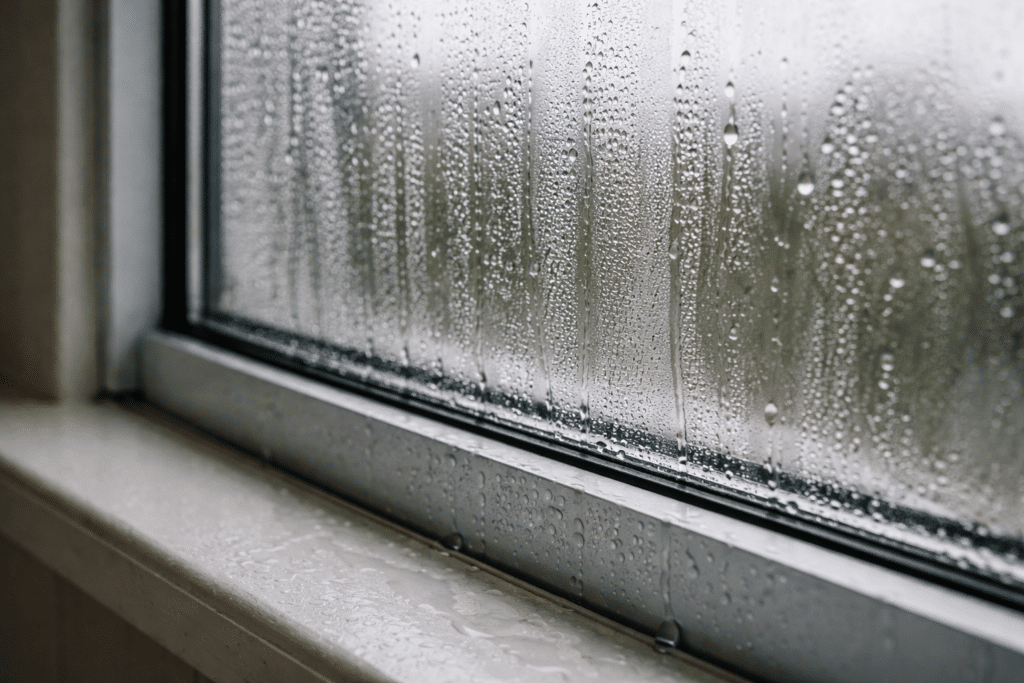
This is why condensation forms on cold surfaces. When warm, humid air inside a room comes into contact with a cold window, wall, or ceiling, the air immediately adjacent to that surface cools down.
As it cools, its capacity to hold moisture decreases. If it cools far enough, the relative humidity at the surface reaches 100% and the air can no longer hold all its moisture, so the excess turns to liquid water on the surface. That transition point is called the dew point.
The dew point is not a fixed number. It shifts depending on how much moisture the air is carrying. In a dry room, the air might need to cool to 5 degrees before condensation forms. In a humid room, condensation could start at 15 degrees.
That is why the same window in the same house can be dry on one night and streaming the next; the difference is the humidity level in the room, which changes the dew point.
Where Indoor Moisture Comes From
Every home produces moisture through daily activities, and the volumes are larger than most people expect.
| Source | Approximate Daily Output |
|---|---|
| Breathing (family of four) | 3 to 4 litres |
| Showering (two showers) | 2 to 3 litres |
| Cooking (including gas hob) | Up to 3 litres |
| Indoor clothes drying | Up to 5 litres per load |
| Unflued gas heater | Up to 1 litre per hour |
| Ground moisture (unlined subfloor) | Variable, significant in wet conditions |
In summer, much of this moisture escapes through open doors and windows. In winter, when the house is sealed up, it stays indoors.
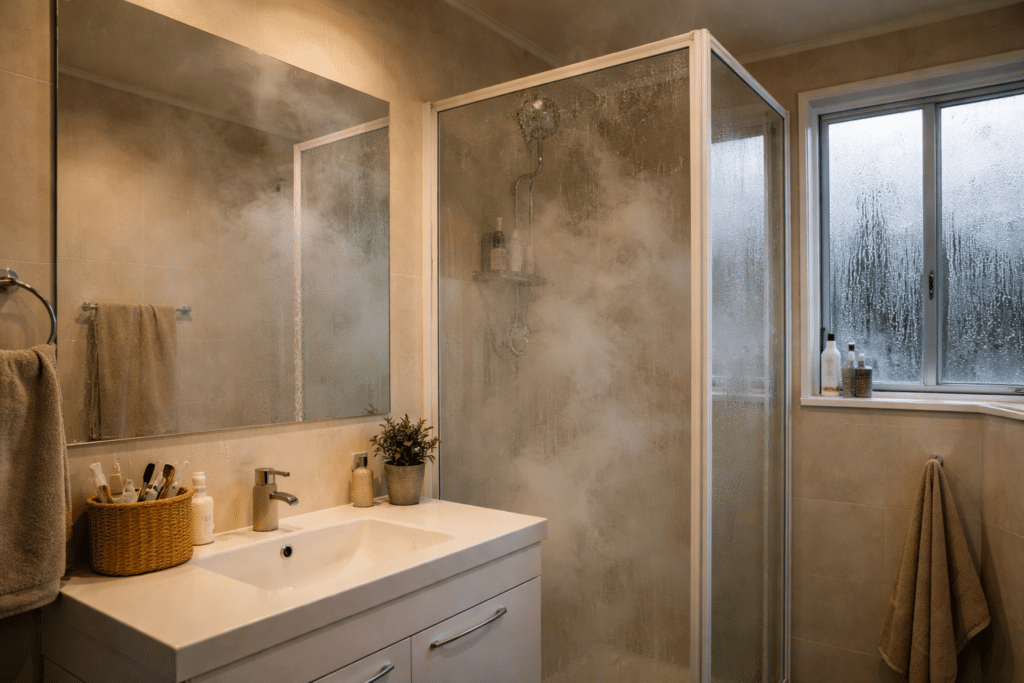
A typical NZ household can easily produce 10 to 15 litres of moisture per day during winter, and most of that has no exit path unless the home has adequate ventilation. That accumulated moisture is what drives condensation across NZ homes during the colder months.
What Humidity Level Is Right
The comfortable and practical range for indoor relative humidity is 40 to 60%. Within that range the air feels comfortable, materials in the home stay dry, and the conditions for condensation and mould are not met on most surfaces.
Once indoor humidity rises above 65% consistently, the risk of condensation increases sharply. At 70% and above, condensation on windows becomes almost inevitable on cold nights, and the conditions for mould growth are met on any surface that stays cool and still.
Below 40%, the air can feel uncomfortably dry, but that is rarely a problem in NZ homes during winter; most homes sit well above this level.
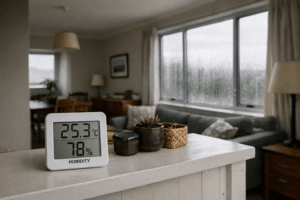
A simple hygrometer from any hardware store will tell you where your home sits. I recommend placing one in the bedroom and one in the main living area, because humidity levels can vary significantly between rooms. Bedrooms often run higher because doors stay closed and breathing adds moisture continuously overnight.
Why It Matters for Your Home
Understanding moisture and humidity is practical because it shifts your perspective from treating symptoms to managing the root cause.
Wiping condensation off windows every morning treats the symptom. Reducing the humidity that causes it treats the problem. The same goes for mould, musty smells, damp bedding, and rooms that feel cold even with the heating running.
All of those issues trace back to indoor humidity being too high for the home to manage. The home’s insulation, glazing, ventilation, and heating determine how well it handles the moisture load, but the moisture itself is the driver. Reduce the humidity, and the symptoms reduce with it.
There are three practical ways to manage indoor humidity, and they work best in combination:
- Ventilation exchanges humid indoor air for drier outdoor air, which is the most direct way to lower humidity. A whole-house ventilation system does this continuously, and simple habits like opening windows briefly each morning and running extraction fans help too
- Consistent heating keeps surfaces warm enough that the air does not reach its dew point on walls and windows. It also prevents the overnight cool-down cycle that triggers heavy morning condensation
- Source control reduces the moisture being produced inside the home. Using extraction fans when cooking and showering, drying clothes outside, keeping bathroom doors closed after showers, and avoiding unflued gas heaters all reduce the total humidity load
Frequently Asked Questions
What is a good humidity level for my home?
Between 40% and 60%relative humidity is the comfortable range. Consistently above 65% means moisture is building up faster than the home can handle, and condensation, mould, and damp-feeling rooms become increasingly likely.
Why is humidity higher in winter?
Indoor moisture production stays the same or increases in winter, but natural ventilation drops because doors and windows stay closed. The moisture accumulates indoors with no exit path. At the same time, cooler surfaces lower the threshold for condensation, so the same humidity level produces more visible moisture in winter than it would in summer.
Does heating reduce humidity?
Heating raises the air temperature, which lowers relative humidity because warmer air has a higher moisture-holding capacity. But it does not remove any moisture from the air, it just changes the percentage. The moisture is still there, and when the heating turns off and the air cools, the relative humidity rises again and condensation returns.
Can I measure humidity at home?
Yes. A digital hygrometer from any hardware store gives you a reliable reading of relative humidity and temperature. Place one in the bedroom and one in the living area to get a picture of how humidity varies across the home. They are inexpensive and useful for tracking whether your moisture management efforts are making a difference.